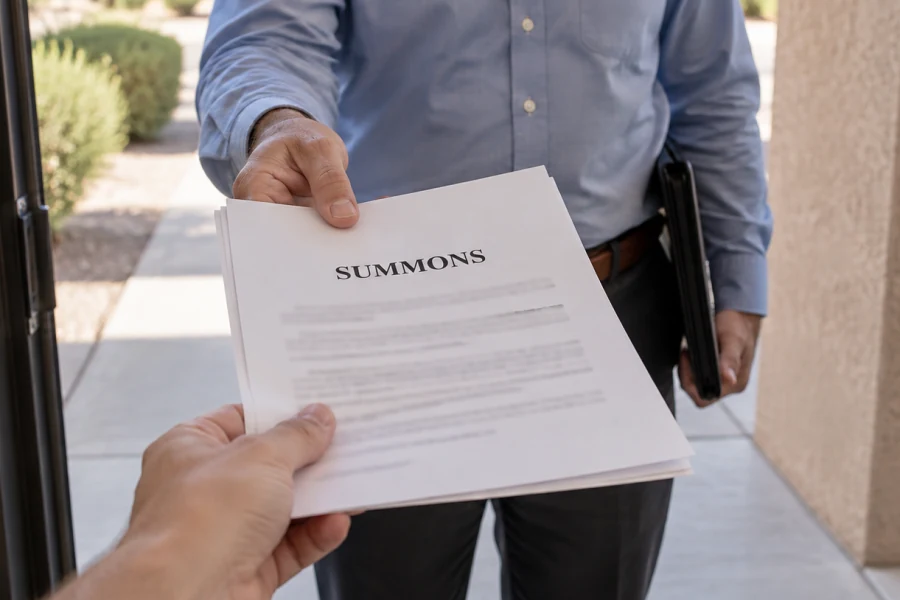
If your Arizona business has been sued, start with three priorities: identify the papers and any deadlines, preserve relevant information, and promptly arrange qualified legal review. Do not wait until you have assembled a perfect file to seek help.
The first review should establish what requires action now and what needs further investigation. Whether the business operates in Oro Valley, Marana, Tucson, or elsewhere in Pima County, a useful response begins with the actual papers and the underlying record.
Confirm what the business received
A demand letter, a summons and complaint, and a subpoena call for different attention. A demand letter presents a position and requests action. A complaint states the claims filed with a court; the summons directs a defendant to respond. A subpoena may require documents or testimony even when the business is not a defendant.
Keep the entire packet, including attachments, envelopes, delivery receipts, and related emails. Identify the court, case number, everyone named as a defendant, and what the other side requests: money, an order restricting conduct, or other relief. Flag any hearing, temporary restraining order, or other emergency paper immediately.
Record when, where, how, and to whom each item was delivered. Ask the employee or statutory agent who received it to preserve their records, including when they forwarded it. Your first personal receipt may differ from the event that matters legally.
Actual receipt and legally effective service are different questions. Give counsel the delivery facts; do not decide for yourself that questionable service means the papers can be ignored.
Have counsel verify the response deadline
There is no single response period for every Arizona business lawsuit. Under Arizona’s civil rules, timing in ordinary superior-court civil cases can depend on the method and location of service, a waiver, the particular response, and applicable rules or court orders. Counsel should verify the deadline for each defendant and any earlier hearing or required action.
An extension or a motion can affect response timing when the governing requirements are satisfied. Asking for more time does not itself establish a new deadline, and not every motion changes the time to respond. Have counsel confirm both the procedural step and its effect.
Failure to plead or otherwise defend can lead to default and then a judgment without the business presenting its defenses in the ordinary way. A default-related notice is an urgent reason to seek help, not a reliable cushion after the original deadline. If a deadline may already have passed, say so immediately; available relief requires prompt assessment and is not assured.
This discussion focuses on ordinary Arizona superior-court civil litigation. Justice court, small claims, federal court, and specialized proceedings—including eviction and emergency injunction matters—can follow materially different procedures. Do not apply a deadline from another court or another case.
Identify who needs representation
Read the names in the complaint carefully. The company, an individual owner, and someone who signed a personal guaranty may each need an assessment. Being involved in the same business does not establish that everyone has the same interests.
A corporation or LLC generally needs a lawyer to appear for it in Arizona superior court. Ownership alone does not authorize a nonlawyer to represent the entity. Narrow exceptions in justice court and small claims do not establish a general right to handle the company’s superior-court case yourself.
Counsel should identify the proposed client, examine potential conflicts, and determine whether joint representation is appropriate or separate counsel is needed. The lawyer for the company does not automatically represent its owners. Also identify who can authorize the engagement and approve business decisions or settlement.
Review insurance promptly
Locate potentially applicable policies and endorsements, including policies from the period involved in the allegations. Depending on the claim, business liability, professional liability, employment, management, or other coverage may deserve review.
Ask counsel and the appropriate insurance contact to assess the policy’s notice and reporting requirements promptly. Provide the papers through the required channel and preserve proof of notice. Do not assume a conversation with a broker satisfies every policy requirement, or that a particular claim will be covered.
Insurance review and the court response need attention at the same time. Notifying an insurer, waiting for a coverage decision, or expecting an assigned lawyer does not by itself stop a court deadline. Confirm who will handle the response and whether that responsibility has actually been accepted.
Preserve the complete record
Preserve relevant contracts, amendments, invoices, payment and accounting records, emails, texts, business messaging, and other electronic information. Include unfavorable documents and complete exchanges. Editing the record into a more persuasive account makes reliable assessment harder.
The duty to preserve relevant electronic information can arise before suit when a specific lawsuit is reasonably anticipated. Arizona’s preservation rule addresses loss of electronic information that should have been preserved. Ask counsel to define the appropriate scope and coordinate with the people who manage the records. Do not wait for a discovery request before addressing preservation.
Flag automatic deletion, disappearing messages, account closures, device replacements, and routine disposal that could remove relevant information. Arrange appropriate steps to prevent that loss. If employees used personal phones or accounts for business, tell counsel and preserve relevant information through lawful, authorized arrangements; do not access someone else’s device or account without authority.
Keep originals and existing versions. Do not alter dates, add explanations to source documents, delete embarrassing messages, or ask anyone to improve their account. Put later explanations in a separate note. If information is already missing, identify what disappeared, when, and what recovery options may exist.
Organize what counsel needs to assess
A concise chronology helps counsel understand the dispute without mistaking a summary for the evidence. Identify important events, the people involved, and the document supporting each entry. Mark estimates, disputed facts, and gaps.
Useful materials include:
- The complete court papers and delivery history for each defendant.
- Signed agreements, amendments, guarantees, ownership documents, and relevant notice or dispute-resolution provisions.
- Financial records showing the amount claimed, payments, credits, and the business’s competing calculation.
- Complete communications, earlier demands and responses, and the names of people with relevant knowledge.
- Potential insurance, prior lawyer involvement, known deadlines, and any missing records.
Explain the practical concern as well: cash flow, management time, an important customer or supplier, access to premises, or continuing operations. Identify the preferred outcome, available resources, and who can make decisions. Counsel needs those facts to assess exposure, defenses, costs, disruption, and realistic settlement objectives.
Organize these materials for counsel, but do not send sensitive documents through an initial inquiry form that requests only nonconfidential information.
Keep communications deliberate
Avoid impulsive admissions, threats, social-media commentary, or an angry reply to opposing counsel. A quick attempt to explain may create a statement that later needs explaining. Coordinate substantive communications with retained counsel and avoid circulating the dispute more widely than necessary.
Copying a lawyer does not automatically make a message privileged. Arizona’s attorney-client privilege protects qualifying legal communications; it does not conceal underlying facts merely because someone told a lawyer about them.
Settlement discussions also require care. Arizona Rule of Evidence 408 restricts certain uses of compromise negotiations about disputed claims, but it does not make every statement unusable for every purpose. A “settlement” label is not a substitute for considering what to disclose.
Evaluate the response and the business objective together
Counsel may assess the claims and requested relief, service and jurisdiction issues, defenses, possible counterclaims, and contract provisions addressing arbitration or other procedures. Some objections require timely presentation. That assessment should guide the response; a particular filing should not be selected simply because it worked in another dispute.
Negotiation or mediation may be useful alongside a litigation response. Settlement discussions do not, by themselves, suspend court deadlines. Counsel should evaluate potential terms, implementation, costs, and the business’s ability to perform any agreement, while continuing to address required court action.
A short first-step checklist
- Keep every paper and record the delivery details.
- Flag hearings, emergency orders, and any possibly missed deadline.
- Arrange counsel’s review of deadlines and representation needs promptly.
- Review insurance notice requirements without waiting to address the lawsuit.
- Preserve complete records, including electronic information and unfavorable material.
- Prepare a concise chronology and identify the business objective.
Common questions
Should I wait until I have all the documents?
No. Explain what you have, what is missing, and any known deadline when seeking legal review. Continue organizing the record while arranging prompt review of the urgent issues.
Can I rely on the other side’s promise to work things out?
Do not treat that promise as a change to a court deadline. Have counsel verify any extension, agreement, or order on which the business intends to rely.
Does a demand-letter engagement cover defending the lawsuit?
Not automatically. Review the existing engagement and confirm the accepted scope with the lawyer. Ask whether litigation, emergency relief, and each defendant fall within that scope.
Start with the papers and a clear objective
My approach to business disputes and early resolution begins with the record, the timing, and the available choices. An early assessment should help the business understand what requires immediate action and what further work would make the next decision better informed.
This post is educational. It is not legal advice about your matter.
Inquire about business-dispute representation
Alexander Ball, PLLC considers selected business disputes. To inquire, provide only a short, nonconfidential description, the parties’ names, and any known deadlines. Do not send confidential documents or strategy. Representation begins only after conflicts and matter-fit review, the firm’s acceptance, and an engagement agreement signed by both the client and the firm. Submitting an inquiry does not retain the firm, stop or extend a deadline, or mean the firm has agreed to act. Do not wait for an inquiry response to address an approaching deadline.